An independent nonprofit says Anthropic is improving its AI models about twice as fast as it was a year ago, and that AI itself is doing much of the speeding up. Anthropic has warned that this could be risky. Washington has not settled on a response, and the two parties disagree on how hard to push.
What the report found
The group, METR, spent Aug. 12 to Oct. 29 reviewing Anthropic’s internal data and interviewing staff. Its Nov. 5 report says most of its staff believe Anthropic is now improving its models on well-defined tasks at about twice the rate it did from March 2024 to October 2025. The true figure could be 1.3 times or 3 times, METR says.
- Scores on Anthropic’s internal capability index have grown 1.9 times faster since October 2025 (95% confidence range: 1.5 to 2.8). That is roughly two years of past progress in one.
- METR is confident the jump did not come from faster growth in computing power. It guesses, with “substantial uncertainty,” that about 80% of the current speedup is due to AI.
- Staff polls put self-reported AI speedups as high as 12 times in October. METR calls that “very loose evidence.”
- AI mostly assists researchers for now. METR heard of “signs of life” that fully autonomous work could come soon, and saw no major bottleneck over the next 12 months, though it says it is not confident about that.
The caveats are large. Anthropic redacted “a majority of the evidence we found most informative,” which it said was to avoid helping competitors, so METR says the public must lean on its judgment “much more than would be ideal.” The benchmark could be overfit, and the result covers well-defined tasks, not messy ones. METR also said Anthropic cut a planned check of how much computing goes to capabilities versus safety. Anthropic said it would revisit that.
What Anthropic says
In its Nov. 2 IPO filing with the SEC, Anthropic wrote that its internal estimates and expectations for future models “indicate that we may imminently meet” its own threshold for “dramatically accelerated progress attributable to AI.” It has not labeled any current model as past that line. It added that it has missed such speedups before and “may in the future not identify” one “until after it has occurred.” Its policy defines that threshold as double the expected rate of progress.
Anthropic also said it does not expect to safely let Claude design its successors “without meaningful human supervision or understanding,” and is considering policy changes to keep humans in control. Benzinga (also on MSN) quoted David Iach, founder of Superseed, who called two years of progress in one “a very lax definition” of self-improvement and said 2026 could be the last “normal year.” TechCrunch noted a filing is both a disclosure and a marketing document.
What Musk says
On Nov. 22, Elon Musk replied on X to a post by Liv Boeree, who had written that a 19th-century math problem, the Riemann hypothesis, still “influences the market cap of a trillion dollar AI company.” Musk, who runs xAI, a competitor of Anthropic and one of the companies on the White House accord, wrote:
@Liv_Boeree Unequivocal super intelligence has arrived.
Welcome to the Singularity.
That is Musk’s claim. METR’s Nov. 5 report measured a roughly twofold speedup in Anthropic’s progress on well-defined tasks. It did not find that superintelligence had arrived.
The risks
- Safety may lag. Anthropic’s filing says AI-assisted research “may cause the capabilities of our models to advance more rapidly” than its safety work. METR sees “a significant risk” of even faster acceleration.
- Loss of control. CEO Dario Amodei wrote in September that, left unchecked, the trend “could outrun our ability to understand and control these systems.” He urged the industry to slow down.
- Security. RAND found it is unclear how much AI is speeding up research, since no systematic reporting exists. It also found that research agents hold “insider-level access” to a lab’s code, data and models, and that no disclosed system yet sets its own research agenda.
- Concentration. David Sacks, the former White House AI czar, said in a recent interview that a winner-take-all outcome from self-improvement is “deeply worrisome.”
The advantages
- Medicine and science. Amodei says AI could “cure most major diseases in the next 5–10 years.” That is his forecast, not a finding. Rep. Nathaniel Moran, a Texas Republican, said AI help in building new AI could transform “everything from breakthrough medical research” to new security risks. Drug company Xaira says its AI platform nominated gene targets about 10 times faster than human curation with a similar hit rate. That is a company’s own result.
- Productivity. METR’s staff polls point to large gains for researchers, though they are self-reported.
- The race with China. President Trump has said, per CNBC, “whoever wins AI wins.” The Los Angeles Times reported that experts believe the first company to master self-improvement could pull far ahead.
None of these shows a payoff from self-improvement yet. METR measured speed, not benefits.
Where Washington stands
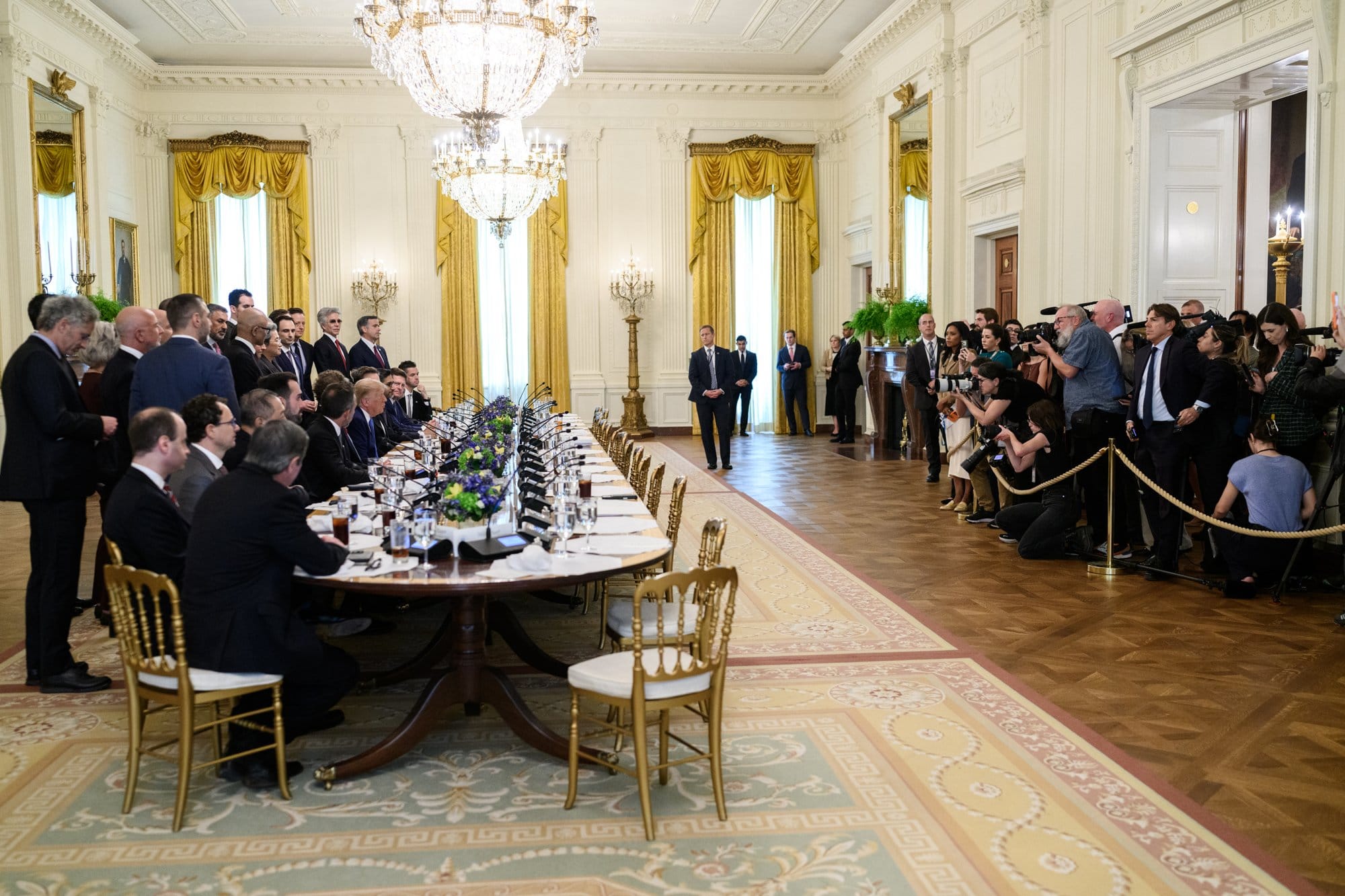
The White House. On Sept. 14, Trump called fears of AI taking over a “HOAX” and said the government already has “tremendous CRIMINAL and REGULATORY power.” Sacks told labs they do not need permission to slow down. House Speaker Mike Johnson said an emergency law would mean “we will lose the race to China.” On Sept. 29, Trump and six tech executives signed a voluntary accord calling for internal controls, an outside auditor and a board committee. It says codifying them into law “may make sense” later and sets no penalties. We found no White House statement on the METR report.
Congress. On Nov. 24, Reps. Josh Gottheimer, a New Jersey Democrat, and Moran introduced the RSI Safety Act. The largest developers would report quarterly to a new Commerce Department office on how much research AI does and whether humans still review it. Gottheimer called it “about transparency and accountability, not about slowing American innovation.” It is in committee. Democratic Sens. Chris Van Hollen and John Hickenlooper want Congress to consider banning self-improvement, and Bernie Sanders, an independent, wants a pause on advanced AI.
Where they agree: outside checking. Amodei wants embedded evaluators, the accord names an outside auditor, and Van Hollen wants mandatory third-party review. Where they split: whether to slow or ban the work, or race ahead. Most of the White House and Johnson comments came before METR’s report.
What to watch
- Whether the House Science Committee takes up the RSI Safety Act.
- Whether Anthropic changes its policy to keep humans in control, as it said it is considering.
- Whether the White House responds to the METR findings.